
Lake Katwe Salt Works
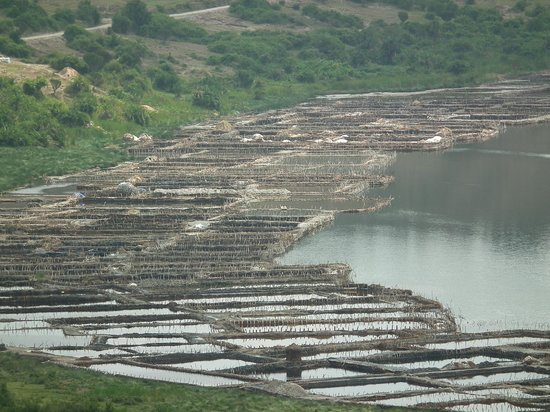
Lake Katwe Salt Works
Lake Katwe Happens to be a salt water lake. Lake Katwe is an ancient lake in the south western part of Uganda in Queen Elizabeth National Park. The lake water is the served by streams and without any outlet hence making it a salty lake with intense evaporation on dry season and have got concentration of minerals in the hyper saline water.
How do crater lakes come about?
Violent volcanic explosions are called explosion craters. About 8000- 10000 years, these geographic features were formed by volcanic activity;
When molten lava from the earth’s crust is trying to escape though a blocked vent or fissure, it uses a lot of pressure.
This is pressure forces the surface leaving behind a wide depression called a crater. The debris from the explosion falls on the sides around the crater forming a realm of volcanic pile. This kind of explosion is called violent volcanic explosion.
When time passes by, the depressions are later filled with water to form a crater lake. This same volcanic processes, is responsible for the formation of most of the crater lakes in western Uganda.
These crater lakes are also called extinct volcanoes, however, a few still releases sulphurous gas smells; meaning, an eruption any time and cause great danger to the neighbors.
There are three major crater lakes in Uganda; Lake Katwe in Queen Elizabeth National Park, Bunyaruguru craters on the magnificent Kichwamba escarpment and Nandali- Kasende in Kibale National Park.
Katwe Salt Lake
Katwe salt lake is located north of Mweya peninsular, in the south western part of Uganda with in Queen Elizabeth national park. The craters in Queen Elizabeth national park are the most exalted craters in western Uganda.
When visiting, you can also engage in the eye catching crater drive of about 27km, with the attracting crater lakes like Katwe and Nyamunuka.
Crater lakes in Queen Elizabeth national park provide a good hiking ground with in queen Elizabeth national park, like around Nyamunuka crater you can watch flamingos, warthogs and other animals.
The reason as to why Lake Katwe is salty, Lake Katwe has a number of water tributaries that bring in water; inlets. However, it has no out lets. This is the main reason also as to why ocean water is saline too. During the dry season, there is a lot of evaporation that makes the salt solution concentrated to make salt rocks.
However this activity of salt mining at Katwe Crater Lake has lost its value. This is because other salt mines have been discovered in many other countries. It was a lucrative economic activity to the residents of Katwe and Katunguru some years back. Salt from Lake Katwe was also exported to Congo and Rwanda before salt was discovered in other parts of east Africa.
How is salt mined from the acidic lake?
Salt production at Lake Katwe in Queen Elizabeth national park is high during the dry season; January to march and July to September are the peak seasons for salt mining. With evaporation in the dry season, makes the saline water of Lake Katwe to concentrate making a hyper solution that forms salt.
The women collect off the crusted salt formed on the surface. It is clear and is the salt that filtered to make table salt. Men, on the other hand, shovel the salt blocks from the bottom of the lake. This is done at the shallow end of the lake.
The mines are separated with wooden walk ways. The salt is extracted in large blocks. The highly crystallized salt is used for human consumption and the dirty muddy salt is sold as salt licks for cows. The muddy salt is also sold at a cheap price because it is used for tenderizing meat and beans locally in Uganda.
Salt mining is not an easy activity
The salt miners stay around the mines the whole day long under the hot sun and the bad smell from the evaporating saline water. Since the salt is in the depression, the temperature is drops so low during the sunny season.
The salty water in Lake Katwe is toxic and very dangerous to the reproductive health of the workers; both women and men. Women put flour in their private parts to avoid the toxic water entering them. Well as the men put on condoms to avoid the water to affect their penises.
It is said that the salty water from Lake Katwe can make a man impotent and a woman barren despite of the endeavors these miners do to prevent sexual problems. These problems facing the salt miners in Katwe have not stopped the mining process; it is their only source of income.
A visit to Katwe salt lake only takes half a day.
Visiting the salt works at Katwe is a half day itinerary during the tour in queen Elizabeth National Park. The guide helps you to get some important information about salt mining and history of the area from the miners.
The salt mining is the main economic activity for the Katwe area. However it is not lucrative anymore as it used to be back in the days. The miners still have very poor standards because the money they get from salt mining is not enough.
You can only support these communities through buying the crafts from the makers; local people. These crafts are made by the local people with a lot of love and stages on the road sides to be sold to the visitors. This is just another way to supplement the salt mining job.
What else around Lake Katwe apart from salt mines
- Culture
- Craft making
- Vegetation and animals along the way
- Living and life style of the locals of Katwe town.
To note, there used to be a factory operating at Katwe to process the salt. The salt at Lake Katwe has toxic chemicals which spoilt the tubes in the factory. Today the Germany salt factory lies in ruins at Katwe salt lake. If the salt spoilt the metal tubes in the Germany factory, what about the humans that go for mining with no protective gear?